









Somewhere right now, a parent is standing in the kitchen with a spoonful of almond butter, feeling great about their life choices. They bought organic. They skipped the drive-thru. They’ve said the words “I eat pretty healthy” out loud to at least three people this week.
And the scale hasn’t moved since spring.
If that’s you, I want you to hear this first: you are not broken, and you are not lazy. After more than 30 years in this industry and over 30,000 training sessions, I can tell you this is one of the most common frustrations I see. Smart, motivated, hardworking people do almost everything right and still get stuck.
The reason is simple, and nobody explains it. Eating healthy and eating for a goal are two different skills.
Two Different Playbooks
Think of nutrition as two playbooks.
Playbook #1 is the “quality” playbook. It cares about whole foods, organic produce, healthy fats, and fiber. It’s why you know avocados are good for you and why you read ingredient labels like they’re mystery novels. This playbook is great for your long-term health, energy, and digestion.
Playbook #2 is the “numbers” playbook. It doesn’t care whether your chicken had a happy life. It cares about how much you eat, how much protein you get, and whether the math lines up with your goal. It’s the gym-bro approach, and yes, it sometimes involves a lot of rice cakes and protein bars that taste like frosting.
Most people live in just one of these. Quality-only eaters eat beautifully and stall out. Numbers-only eaters hit their targets but run on processed food and wonder why they feel flat by 3 p.m.
You want both. Whole foods as the foundation, with a little math layered on top.
Why “Clean” Doesn’t Automatically Mean “Lean”
Here’s the part nobody wants to hear, and I say it with love: you can eat the healthiest food and still not lose a pound.
Fat loss comes down to energy balance. To lose body fat, your body has to use more energy than you take in over time. If you’re not in that zone, your body has no reason to dip into its stored reserves, no matter how clean the groceries are.
Quinoa bowls and kale do not come with a special calorie exemption. I wish they did. I’d have a much easier job.
Healthy Foods Can Be Sneaky
Here’s what trips up a lot of well-meaning parents. Many of the “good for you” foods are also very calorie-dense, and the reason is fat.
- Fat has 9 calories per gram.
- Protein has 4 calories per gram.
- Carbohydrates have 4 calories per gram.
Fat packs more than double the energy per gram. So consider a typical “healthy” day:
- A generous glug of olive oil in the pan
- Half an avocado on toast
- A scoop of nut butter in the smoothie
- A handful of almonds at 3 p.m. (okay, a few handfuls)
- Cheese on the salad, plus dressing
Every one of those foods is nutritious. Together, they can add up to a few hundred calories more than you realized, and none of it came from a drive-thru. Nobody ever tracks “a drizzle” of olive oil, and my drizzle and yours are not the same measurement.
Meanwhile, those same days are often short on protein, and that’s where things really start working against you.
The Protein Problem
If you’re strength training, or even just trying to keep up with your kids without feeling wiped out, protein deserves a spot at the top of your priority list. When protein runs low for too long, a few things tend to happen:
- Your body has a harder time building and keeping muscle
- When you cut calories, you’re more likely to lose muscle along with the fat
- Your metabolism can slow as muscle declines
- You feel hungrier and snackier
- You never quite feel full
Muscle is metabolically active tissue. The more of it you keep, the easier long-term fat loss becomes. Losing it makes everything harder, including carrying groceries and a toddler at the same time.
Protein works best when you plan it instead of hoping it happens by accident. A good rule is to build each meal around a protein source first, then add your produce, healthy fats, and carbs around it. Your exact needs depend on your size, your activity, and your goals, which is one reason a personalized plan beats guessing.
Building the Middle Path (Without Losing Your Mind)
You don’t have to choose between “clean” and “calculated.” Here’s what the middle path looks like on a real plate:
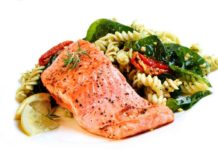
- Pick the protein first. Eggs, Greek yogurt, chicken, lean beef, fish, turkey, cottage cheese, beans. Start there.
- Be intentional with fats. Keep them, because they’re healthy, but measure them for a week or two so you know what a tablespoon of olive oil actually looks like.
- Load up on produce. Fiber and volume keep you full on fewer calories.
- Choose your carbs on purpose. Fuel your workouts and your day, instead of letting them sneak in as crackers eaten standing at the pantry.
Take a breakfast like an omelet loaded with veggies, a side of fruit, and a modest portion of avocado. That’s whole food, real nutrition, and a solid hit of protein, without turning your morning into a calorie bomb. Compare it to the “healthy” breakfast of a giant smoothie with three scoops of nut butter and granola on top. Same good ingredients, very different result.
Tracking: A Short Class, Not a Life Sentence
The moment I say “track your food,” half of you picture logging every blueberry until you’re 80. Relax. Nobody’s doing that.
Think of tracking as a one- or two-week crash course in your own eating habits. It’s a teaching tool, not a life sentence. Most people who try it discover a few things:
- Portions are bigger than they thought. “A handful” is a very flexible unit of measurement.
- Hidden fats add up fast. Cooking oil, dressings, and cashews eaten straight from the bag count.
- Protein is lower than expected. Almost everyone is surprised here.
- Some foods fill you up more than others. A small pile of nuts and a full plate of chicken and veggies might have similar calories, but they feel completely different in your stomach.
After a couple of weeks, you build an instinct for it. You’ll know what a good portion looks like, and you can stop logging and just eat with confidence. That clarity quiets a lot of the food noise in your head too, which is a win for any parent who already has 47 other things to think about.
A Quick Reality Check for Busy Families
I know what your week looks like. Soccer practice, dance pickup, school events, work calls, the commute, and a Saturday that somehow disappears. Add the weather, a million dining options between here and there, and the “I’ll just grab something” trap, and it’s no surprise nutrition gets chaotic.
The answer is not perfection. It’s a simple system you can repeat on your busiest days: protein at every meal, produce in your cart, a plan for dinner before 4 p.m., and a few go-to meals that work for the whole family.
That’s exactly why I created Busy Parent Health & Fitness, my 4-week program designed for parents who don’t have two free hours a day to spend at the gym or in the kitchen. It gives you workouts you can actually fit into real life, along with practical guidance so your effort turns into results.
And if dinner is where things fall apart, my recipe collection Thin in the Kitchen is packed with meals that are family-friendly, flavorful, and built with this balanced approach in mind. You can also browse my other topic-specific ebooks at jcguidry.com for help with weight loss, muscle building, and more.
Whole foods, a little math, and a plan you can stick to is what gets results. If you live in Fulshear and you’re ready to stop spinning your wheels, grab the book, start this week, and give your almond butter spoon a little less pressure to do all the work.